
Step ladder packaging affects far more than the appearance of a shipment. For importers, distributors and private-label programs, carton dimensions, protective materials and container loading plans influence freight cost, warehouse handling and the condition of the product when it reaches the buyer.
This practical guide explains what to confirm before placing a wholesale step ladder order—whether you are sourcing a compact household model, a wider carbon-steel ladder or a customized retail range.
Why step ladder packaging should be confirmed early
The finished ladder may look simple, but a successful export order requires the product, carton and loading plan to work together. A carton that is too loose can increase movement in transit. A carton that is unnecessarily large can waste container space and raise freight cost. The most efficient approach is to review packaging at the same time as the ladder model, size, color and target market.
Start by selecting the appropriate product family from our step ladder range. The folded profile, handrail design, step count and material all affect the final outer-carton size.
1. Match carton dimensions to the folded ladder
For folding step ladders, the folded height and the widest point are the starting measurements. The carton needs sufficient clearance for protective materials without leaving excessive empty space. This is especially important for household step ladders with wide pedals, handrails or accessory trays.
- Confirm the folded dimensions for each step-count option.
- Keep the carton profile practical for manual handling and retail storage.
- Review carton length before booking 20GP or 40HQ container space.
- Use one consistent carton rule for repeat wholesale orders whenever possible.
2. Protect the points most likely to be damaged in transit
Protective packaging should focus on corners, feet, handrails, hinges and visible powder-coated surfaces. For carbon-steel step ladders, stable internal positioning helps prevent surface rubbing. For aluminum step ladders, separators and edge protection can help preserve the finish during mixed-container shipments.
During sampling, ask the supplier to check the ladder after normal carton handling—not only before packing. This makes it easier to identify where additional edge protection, a polybag or a revised inner support is useful.
3. Plan container loading before carton artwork is finalized
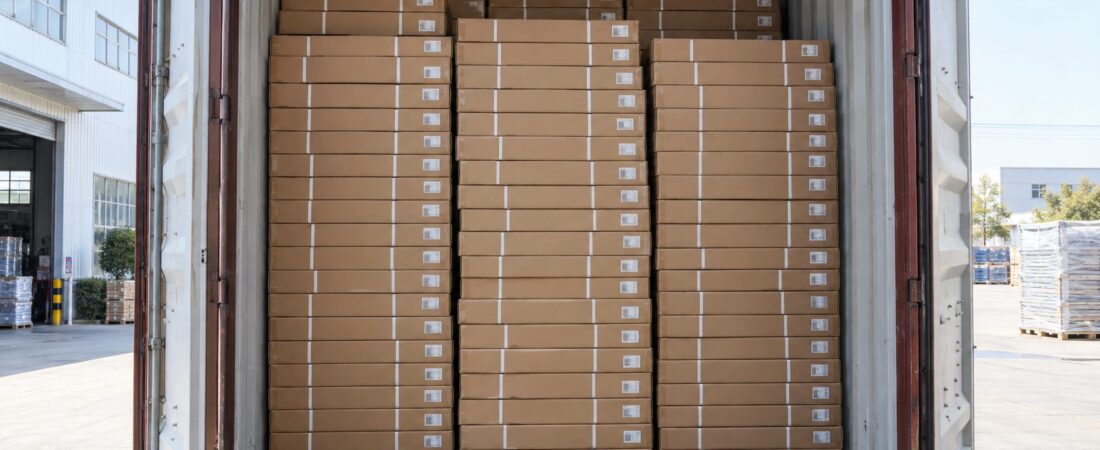
Container loading for step ladders works best when carton dimensions are designed around a repeatable loading pattern. Cartons should stack in straight, stable columns with clear orientation marks and as little void space as practical. A loading plan also makes it easier for the buyer’s warehouse team to count and receive the shipment.
Our factory and export-loading process is set up to review carton size, packing sequence and shipment readiness together. For mixed orders, we can discuss how the selected models can be grouped to make container use more efficient.
4. Build a private-label carton buyers can use
A private-label step ladder program may need more than a plain brown carton. Before printing, confirm the items that matter to the retail channel: model number, color reference, barcode position, warning labels, user manual language and carton artwork. Keep the layout easy to identify from a distance while maintaining the carton strength required for transport.
For OEM projects, review logo placement, color, labels, manuals and carton requirements before production starts. Learn more about our OEM ladder customization options.
What to include in a step ladder packaging RFQ
- Ladder model, material and step count
- Target market and planned sales channel
- Required color and private-label elements
- Expected order quantity and destination port
- Carton artwork, barcode or label requirements
- Whether the order will be full-container or mixed-container loading
Choose a supplier that can connect product and packing
Good step ladder packaging is a sourcing decision, not an afterthought. By confirming the product configuration and carton plan early, importers can reduce uncertainty before mass production and prepare for smoother warehouse receiving.
If you are comparing carbon-steel models, browse our carbon steel step ladders, then use the factory page to review production, warehouse and export support.